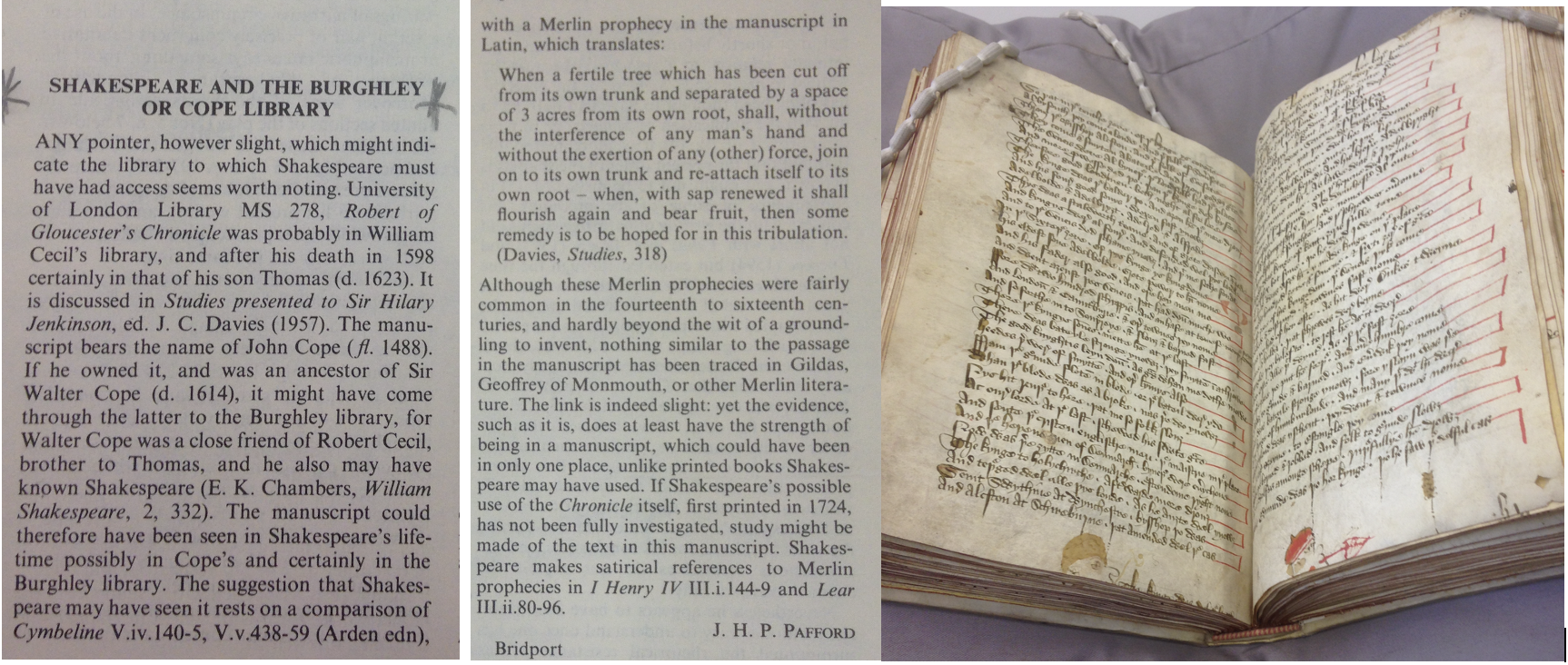
I combine my research in philosophy with a background in the liberal arts and interest in Elizabethan literature, especially Shakespeare. In the picture above you see MS 278, which I came across while studying at King's College London. The scribe of this manuscript painted funny heads in the margins of the manuscript. It may be well the case that Shakespeare himself was reading this book and enjoying these funny heads.
I claim that a supplementary reading of Hamlet highlights and explicates as of yet unacknowledged literary aspects in the Meditations and that these literary aspects are not only particularly suitable for making this text more tangible for students taking their first philosophy class but also clarify its analytic method of presentation, which Descartes describes in his Replies to the Second Set of Objections and of which he says that it is the ‘best and truest method of instruction’. The Meditations presents its arguments in the form of a dramatic structure: the progression from radical doubt to the discovery of clear and distinct ideas and the subsequent restoration of knowledge tracks Gustav Freytag’s dramatic pyramid of exposition, rising action, climax, falling action, and denouement.
Works under review:
Aristotle and Shakespeare on Cartharsis
I examine A Midsummer Night’s Dream, a comedy which achieves its comedic effect by avoiding tragedy, and Romeo and Juliet, a tragedy which achieves its tragic effect by failing to be comedy, and explain how tragedy understood as a failed comedy can evoke a catharsis. Romeo and Juliet begins with a comedic exposition, changes genre at the climax, and ends in tragedy. The turn from comedy to tragedy in Romeo and Juliet has been observed, but I specify the mechanics that sustain a catharsis through this change of genre. The catharsis is not sustained by what Aristotle calls hamartia (a mistaken action due to a lack of knowledge), but rather by atychia (an unfortunate action due to circumstances that misalign intention and consequence). Romeo's downfall is precipitated at the climax of the play by his attempt to part Mercutio and Tybalt, which inadvertently results in Mercutio’s death. The audience pities Romeo because he fails despite his best intentions and fears to become subject of such circumstantial forces itself. In this way, tragedy as failed comedy achieves a catharsis without adhering to rules of Aristotle’s theory, such as the nobility requirement on the protagonist to facilitate a steep downfall, that have become obsolete for interpreting modern tragedy.
Elazar Benyoëtz on the Book of Job
The poetry of Elazar Benyoëtz, which has not received the attention it deserves, despite winning several awards. Benyoetz immigrated from Austria to Israel to flee from the Nazis but writes in his second language German. I discuss his interpretation of the Book of Job in Scheinheilig and give a threefold analysis that takes into account the literary, theological, and philosophical aspects of his interpretation. From a literary perspective, the repetition of etymological roots suggests a legal reading where Job raises a legitimate question but lacks legal standing to bring it up in court, so to speak. Philosophically, Benyoety suggests that Job (and not his friends) were right. God made an error and Job's complaint, though it lacked legal standing, prompted God to rectify a mistake He made. Theologically, Job did not "enthimmel" his faith in the sense that he lost it but in the sense that he has a more realistic and less romanticized understanding of God.